How to Choose Kitchen Furniture: A Practical Guide to Cabinets and Finishes
Planning a new kitchen involves a lot of decisions arriving at once, and most people find the furniture side of things the most confusing. The terminology alone, carcasses, fronts, handleless, integrated, is enough to make a showroom visit feel daunting before you have even looked at a single door sample.
This guide cuts through that. It walks you through the main types of kitchen furniture, explains what actually matters for quality, and helps you think about finishes, materials and storage in a way that connects those choices to how you actually live. By the end, you should have a clear enough picture to start a conversation with a kitchen designer with confidence. If you would rather start that conversation now, the team at The Kitchen Store designs and installs fitted kitchens across Sussex and Surrey.
The Building Blocks: Types of Kitchen Cabinets
Before you choose a style or a finish, it helps to understand what the different cabinet types are and what job each one does. Here is a plain-English rundown of the main pieces.
Base cabinets
Base cabinets sit on the floor and form the working spine of the kitchen. They carry the worktop, house the sink and hob, and provide the bulk of your everyday storage. Standard depth is 600mm, though shallower options exist for galley kitchens or narrow runs. Drawer base cabinets, where the full cabinet opens as a stack of deep drawers rather than doors with a shelf inside, are now more popular than traditional base cabinets in well-specified kitchens because they make everything accessible without crouching.
Wall cabinets
Wall cabinets mount above the worktop and are typically 300mm deep. They are useful for lightweight everyday items, glasses, dry goods, crockery, but they limit the amount of natural light that reaches the worktop and can make a kitchen feel enclosed. Many homeowners are reducing the number of wall cabinets in their kitchens, using open shelving or a run of tall cabinets instead. If you do use wall cabinets, matching their height and depth consistently makes a significant difference to how tidy the finished kitchen looks.
Tall cabinets
Tall or full-height cabinets run floor to ceiling and are the most storage-efficient option in a kitchen. They work well for larder storage, housing integrated ovens and combination cabinets, and hiding fridge-freezer columns behind matching doors. A bank of tall cabinets at one end of the kitchen, balanced by base cabinets and an open worktop on the other side, is a common layout in both contemporary and more traditional fitted kitchens.
Islands and peninsulas
An island is a freestanding or fixed cabinet in the centre of the kitchen floor, unattached to any wall run. A peninsula extends from a wall run into the room. Both provide additional worktop, storage and often seating. They work best in kitchens where the floor area allows a comfortable clearance of at least 900mm on all working sides.
Freestanding pieces
Not all kitchen furniture needs to be built-in. Freestanding pieces, a dresser, a butcher's block, a larder cupboard or a dedicated storage cabinet, can add warmth and character that an entirely fitted kitchen sometimes lacks. More on these below.
Carcasses vs Fronts: What Actually Matters for Quality
This is one of the most important things to understand when comparing kitchen quotes, because it is where the real quality differences lie.
The carcass is the structural box, the sides, base, top and back panel of the cabinet. The front is the door or drawer face you see. Most people focus on the fronts because they set the visual style of the kitchen, but the carcass is what determines how well the kitchen performs over ten or twenty years.
What to look for in a carcass
Thickness. An 16mm carcass is the minimum for a kitchen that will hold weight without flexing. Well-specified kitchens use 16mm throughout, including the back panel.
Material. Moisture-resistant particle board, MDF or HDF is the right choice for kitchen environments, particularly in base cabinets near the sink or dishwasher. Jointing and assembly. Dowel-and-cam construction is standard; a carcass with glued and screwed corner joints, as well, is more robust.
Drawer runners. Soft-close undermount runners are the benchmark. They carry more weight than side-mount runners, close quietly and last significantly longer under daily use.
Hinges. Concealed hinges with a soft-close mechanism and at least a six-way adjustment. This matters because kitchen doors need realigning over time as the building moves and settles.
The fronts
Door and drawer fronts determine the look of your kitchen. The main variables are the material, the finish and the profile. Painted MDF fronts are a popular choice for contemporary kitchens because they take colour consistently and are easy to touch up. Solid timber fronts bring natural variation and warmth. Modern vinyl-wrapped fronts are a lower-cost option and very realistic.Profile refers to the door shape: flat (shaker or slab), raised panel, or in-frame. Flat doors dominate modern kitchen design; in-frame cabinetry, where the door sits within a visible timber frame, is a hallmark of traditional and high-end handmade kitchens.
Once you have understood the structure, the finish choice is the one that shapes how the kitchen looks and feels every day.
Handleless vs handled
Handleless kitchens use a routed grip channel or a push-to-open mechanism instead of a handle. They read as clean and contemporary, work well in open plan layouts where the kitchen is on view from the living area, and are easier to wipe down. Handled kitchens give you a wider range of stylistic expression, from slimline bar handles to cup handles to statement hardware. The choice between them is partly aesthetic and partly practical. Our guide to handleless kitchen pros and cons covers the decision in detail if you are weighing up both.
Matt vs gloss
Matt finishes have dominated kitchen design for the past several years and show no signs of fading. They do not show fingerprints as readily as gloss, they photograph well, and they feel more current in most contexts. High gloss finishes reflect light and can make a smaller kitchen feel larger, but they show marks easily and need more maintenance to keep looking good. Silk and satin finishes sit between the two and are a practical compromise in busy households.
Woodgrain and painted finishes
Painted finishes in soft neutrals, warm whites, deep navies or sage greens give the most flexibility and the widest range of pairing options with worktops and flooring. Woodgrain finishes, whether in a true timber veneer or a high-quality foil, bring warmth and texture. Mixing the two, painted uppers with a woodgrain island, or vice versa, is one of the most effective ways to add visual interest to a contemporary kitchen without it feeling busy.
Matching Furniture to Worktops and Materials
The relationship between cabinetry and worktop is one of the most important in the kitchen. Get the pairing wrong and the whole room can look disconnected. The fundamental principle is contrast or continuity: either the worktop and cabinetry are clearly in the same family (warm tones together, cool tones together), or there is a deliberate, confident contrast between them. Mid-tones on both often produce a flat result. Our dedicated guide to kitchen worktop materials covers quartz, granite, solid timber, Corian and laminate in detail, including which finishes pair best with different cabinet colours.
A few practical principles worth knowing: light cabinetry works with almost any worktop material; dark cabinetry needs a lighter worktop or very deliberate lighting to avoid the kitchen feeling heavy; woodgrain cabinets pair well with stone worktops; and handleless kitchens almost always benefit from a more textured or patterned worktop surface to add visual interest in the absence of hardware.
Freestanding vs Fitted Furniture
Most kitchens are fitted, meaning the cabinets are built in and fixed to the walls and floor. But freestanding kitchen furniture has grown considerably in popularity, both as a primary approach and as a way of adding character to an otherwise fitted kitchen.
A fully freestanding kitchen, where every cabinet is an independent piece of furniture on legs, suits certain home types well: period properties where fixed cabinetry would damage original features, rental properties where flexibility matters, or clients who want a more relaxed, unfitted look.
More commonly, freestanding pieces work alongside fitted cabinetry. A painted dresser in the dining end of a kitchen diner, a butcher's block as a mobile prep station, or a larder cupboard that adds storage without requiring a building-in job. Our guide to freestanding kitchen storage covers the best options and how to integrate them with a fitted kitchen.
Storage and Functionality: Choosing for How You Cook
The most common regret people have after a kitchen installation is not about the colour or the worktop. It is about storage. Specifically, not enough of the right kind in the right places.
The principle to apply here is: think about what you do in the kitchen first, then choose the cabinets that support those habits. A household that bakes heavily needs deep drawers for trays and large mixing bowls, ideally near the oven. A household that entertains needs easy access to glassware and a clear run of worktop near the hob. A household with young children needs lower storage that they can reach and integrated bins that cannot be easily opened.
The case for drawers over doors
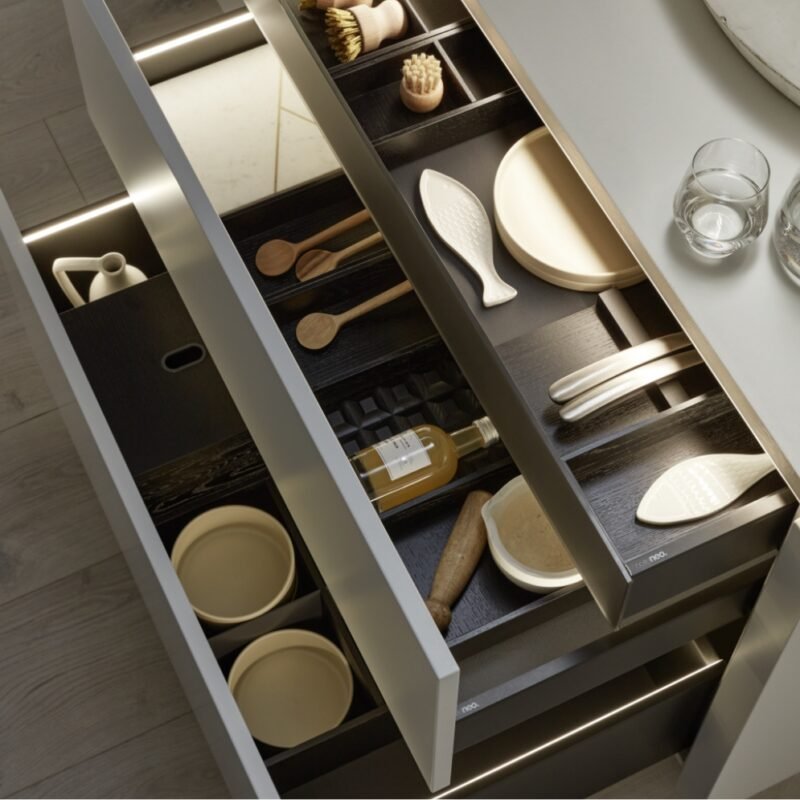
Deep pan drawers are more practical than base cabinet shelves for most households because everything is visible and accessible without bending down to rummage at the back. A three-drawer base cabinet at the hob for pots, pans and utensils is one of the most consistently useful changes clients make when replacing an existing kitchen.
Internal organisation
Pull-out larder cabinets, cutlery inserts, spice drawers and waste sorting systems are not luxuries. In a well-designed kitchen, they replace the chaos of crammed shelves and overcrowded drawers with a system that actually works. Budget for internal organisation as part of the overall kitchen spend rather than as an afterthought, because it is significantly harder and more expensive to retrofit.
Appliance storage
Integrated appliances, dishwashers, fridges, bins, ovens, all hidden behind matching cabinetry fronts, produce the cleanest look and are the right choice in most fitted kitchens. The main trade-off is cost: integrated appliances require cabinetry built around them, which adds to the overall cabinet count and the installation complexity. In a smaller kitchen, some freestanding appliances with matching panels on the sides can achieve a similar effect at a lower cost.
Getting It Right: Why a Design Consultation Helps
Reading about kitchen furniture is useful. But there are limits to how far a guide like this can take you, because the right choices depend on your specific room: its dimensions, its natural light, its relationship to adjacent spaces, how you cook and how your household uses the space.
A kitchen designer brings three things to that process that are hard to replicate alone. First, spatial knowledge: the ability to look at a room and immediately see what is and is not possible, where the compromises lie, and how to make the most of what you have. Second, material knowledge: hands-on familiarity with how finishes actually look and wear in real kitchens, not just on a screen or in a brochure. Third, coordination: the ability to hold the whole project together across cabinetry, worktops, appliances, flooring and lighting so that the result is coherent rather than a collection of individually good choices that do not quite work together.
At The Kitchen Store, every project begins with a design consultation at one of our showrooms in Brighton and Hove, Horsham or Guildford. You can see the furniture ranges and finishes in person, talk through your project with an experienced designer, and leave with a much clearer picture of what is right for your home.
Next Steps
Choosing kitchen furniture does not need to be as overwhelming as it first appears. Start with the cabinet types and what job each one needs to do in your kitchen. Think about carcass quality before you get drawn into door colours. Choose a finish that you will live with for a decade rather than one that is fashionable right now. And pair your cabinetry with worktops and flooring as a family of choices rather than one decision at a time.
When you are ready to take the next step, book a design consultation with The Kitchen Store and bring your measurements, some images of kitchens you like, and the questions this guide has raised. That is exactly the conversation our designers are here for.