Open Plan Kitchen Ideas and Designs: A Complete Guide
An open plan kitchen is one of the most significant changes you can make to a home, and one of the most searched-for topics in kitchen design. But the phrase covers a wide range of layouts, from a modest knock-through between a kitchen and a dining room to a full rear extension with a kitchen, dining area and sitting room all sharing one floor. This guide covers the real open plan kitchen ideas that work, how to get the design right, and the honest practical questions you should be asking before committing to the layout. All projects referenced are by The Kitchen Store, designing and installing kitchens across Sussex and Surrey.
Open Plan Kitchen Design Ideas: Layouts That Actually Work
The best starting point for open plan planning is layouts, not finishes. Understanding the structural shape of the space tells you what is and is not possible before you start thinking about materials and colour.
The kitchen diner
A combined kitchen and dining space, usually running along the back of a terraced or semi-detached house, is the most common open plan result in Sussex and Surrey. The wall between the rear reception room and the kitchen comes down, and the two spaces merge into one continuous room. Done well, this is one of the most useful floor plan changes available to a family home because it puts the cooking and eating in the same space without requiring a large footprint. The key decisions are where the kitchen run sits (typically against the external wall where services already run), where the dining table goes, and whether an island makes sense in the floor area that remains.
Kitchen, dining and living: the full open plan
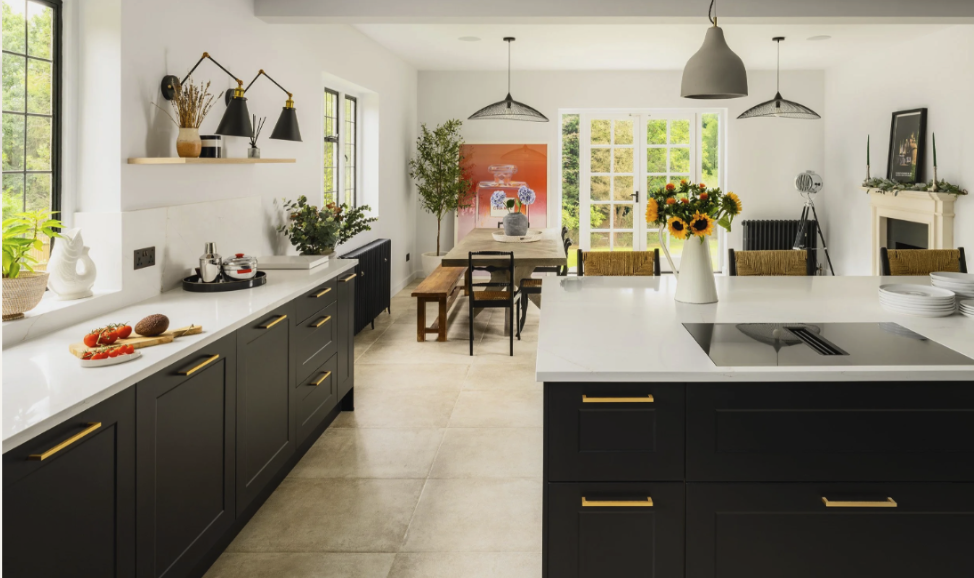
The larger step is removing all internal walls on the ground floor to create a single space shared by the kitchen, dining area and sitting room. This almost always requires a rear extension to give the depth the layout needs. Our open plan kitchen project in Masterclass shows how this full-length layout works in a Brighton home, with a kitchen run along the external wall, an island as the social and visual anchor, and the dining and sitting areas stepping back toward the garden. The sightline from the front door through to the garden glazing is what makes it feel genuinely generous.
Island-led open plan
In a large open plan space, the island does more structural work than it might appear to. It defines where the kitchen zone ends, and the dining zone begins without a wall; it provides seating on the dining side and storage on the kitchen side, and it gives the cook a social anchor point so that whoever is in the kitchen is still part of the room rather than facing a wall. For island design, dimensions and workflow, see our dedicated guide.
Single-wall open plan
Where the floor area does not allow for an island, a single-wall kitchen, all units on one run against the back wall, with a freestanding dining table in front, is a clean and underrated layout. It keeps the kitchen compact, leaves the floor area open, and works particularly well when the back wall is terminated by a run of full-height cabinetry that anchors the composition.
Modern Open Plan Kitchens: The Look and How to Get It
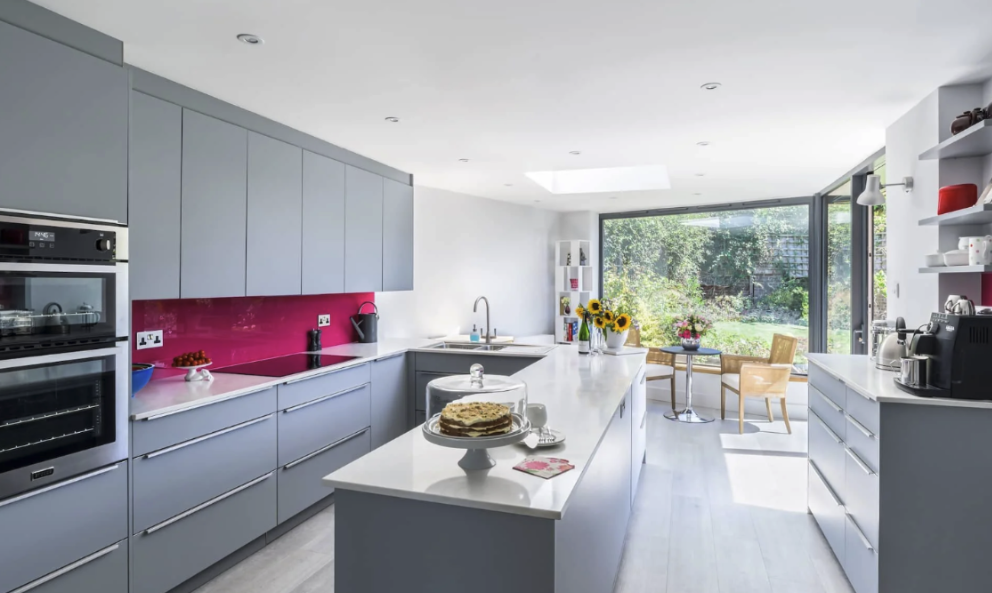
Modern open plan kitchens are defined by a few consistent design moves: handleless cabinetry, integrated appliances hidden behind matching door fronts, tall banks of full-height units at one end of the run, and a clean sightline from one end of the space to the other. The kitchen reads as an architectural element of the room rather than a piece of furniture inserted into it.
Handleless cabinetry in an open plan setting
Handleless fronts, whether routed J-pull or push-to-open, work particularly well in open plan kitchens because the kitchen is visible from the living end of the room at all times. Hardware on each door would read as visual noise across a long run of cabinetry. A flat, handleless surface reads as calm and coherent from a distance. The practical trade-off is that push-to-open mechanisms require more precision in cabinet alignment over time and can be less intuitive for young children.
Integrated appliances
In a modern open plan kitchen, fridge-freezer columns, dishwashers, ovens and wine coolers all sit behind matching door fronts. The result is a kitchen where the only visual break in the cabinetry is the hob and the sink. This level of integration adds to the cost of the project, primarily because it requires cabinetry built precisely around each appliance, but it is the single biggest contributor to the clean look most people associate with a modern open plan kitchen.
Tall storage banks
A run of full-height cabinetry at one end of the kitchen, housing the fridge-freezer columns, a bank of ovens and warming drawers, and the larder storage, is both the most practical storage solution in a large open plan kitchen and the most effective visual anchor. It creates a deliberate end to the kitchen zone and gives the room a sense of composition.
Zoning an Open Plan Kitchen: Making One Big Room Work as Several
The most common mistake in open plan kitchen design is treating the space as one undifferentiated room rather than a series of zones that happen to share a floor. Zoning is the design skill that separates a well-functioning open plan from a chaotic one.
Flooring as a zone marker
Changing the floor material between the kitchen zone and the living zone is one of the most effective and cost-efficient zoning tools available. Porcelain tiles or polished concrete through the kitchen and dining area, switching to engineered oak or a warm carpet in the sitting area, creates an immediate visual and physical signal that you have moved from one space to another. The transition line does not need to be sharp: a slight overlap or a border detail makes the change feel considered rather than arbitrary.
The island as a room divider
An island positioned in the middle of the floor, perpendicular to the main kitchen run, is the most functional way to define the boundary between kitchen and dining zone. The cooking side faces the hob and the prep area; the dining side provides seating, which orients that end of the island socially. The island creates separation without closing the space off.
Lighting zones
Running kitchen task lighting, dining pendants and living area ambient lighting on separate circuits means the mood of each zone can be shifted independently. In the evening, dimming the kitchen zone and bringing up the dining pendants above the table immediately changes the function of the room from practical to social. This is one of the most effective and least expensive tools in an open plan kitchen, and one of the most frequently overlooked at the planning stage.
Broken plan: the middle-ground answer
Broken plan is an evolving approach that uses low walls, half-height cabinetry, structural posts, changes in ceiling height or glazed partitions to create visual separation between zones without fully closing rooms off from each other. It has grown in popularity because it keeps the light and connectivity of an open plan while addressing the noise and smell problems that a completely open layout can create. For families with young children or for households where working from home means needing a degree of acoustic separation, broken plan is often the better answer than a fully open floor.
Is Open Plan Right for You? An Honest Look at the Pros and Cons
Open plan is not a universal solution. Here is a straightforward breakdown by benefit and trade-off.
The genuine benefits
Light. Removing internal walls, especially across the back of a north-facing terrace, transforms how natural light moves through the ground floor.
Sociability. Cooking while still part of the conversation is the single most cited reason clients choose open plan.
Space. A combined kitchen and dining area almost always feels larger than two separate rooms of the same total area.
Property value. In the Sussex and Surrey market, a well-executed open plan rear is now near-standard expectation among buyers in the family home segment.
The trade-offs
Cooking smells. Without walls to contain them, smells travel freely through the whole space. Good extraction is not optional.
Noise. Open volumes and hard surfaces amplify sound. A busy family kitchen in a fully open plan space can be very loud.
Heating. Large open spaces with rear glazing and high ceilings cost more to heat. Underfloor heating is almost always the right answer.
Visibility. The kitchen is on show at all times. Storage quality and worktop discipline matter more in open plan than in any other kitchen type.
If the trade-offs concern you, broken plan, described above, is worth considering before ruling out the concept entirely.
Practical Considerations Before You Commit
Structural walls and RSJs
Not every wall between a kitchen and a dining room is easy to remove. Some are load-bearing, which means the weight they carry needs to be transferred to a steel beam (an RSJ) spanning the opening. This is routine work for a structural engineer and a good builder, but it adds to the project cost and programme and needs to be assessed by a professional before you commit to the layout. Never assume a wall is non-load-bearing without checking.
Ventilation and extraction
Extraction is the most practically important appliance decision in an open plan kitchen. A recirculating extractor that handles cooking smells in an enclosed kitchen will not cope in a large open space. Ducted extraction vented directly outside, with a motor rated for the cubic volume of the room, is the baseline. Island hobs require either a ceiling-mounted hood or a downdraft extractor integrated into the worktop. Premium downdraft options from brands like BORA sit flush with the worktop and are particularly effective in island-led layouts where a ceiling hood would interrupt the sightline.
Heating
Underfloor heating is the most effective solution for a large open-plan kitchen and living space because it heats the whole floor evenly without radiators competing with cabinetry runs or creating cold spots in the living end of the room. If underfloor heating is not viable, oversized radiators positioned carefully in the living zone are the practical alternative. This is a decision to make at planning stage, before the floor goes down.
Why a design survey matters
The combination of structural assessment, extraction specification, heating design and cabinetry layout means that a large open plan project has significantly more moving parts than a standard kitchen replacement. Getting a designer and a structural engineer involved before the building work starts, rather than after, saves money and avoids the costly corrections that come from decisions made in the wrong order.
Plan Your Open Plan Kitchen with The Kitchen Store
Open plan done well is one of the most transformative projects available to a family home. Open plan done without proper planning creates a space that is noisy, difficult to heat and impossible to keep tidy. The difference is almost always made at the design stage. Book a design consultation at our showrooms in Brighton and Hove, Horsham or Guildford and bring your floor plan, your measurements and the questions this guide has raised.